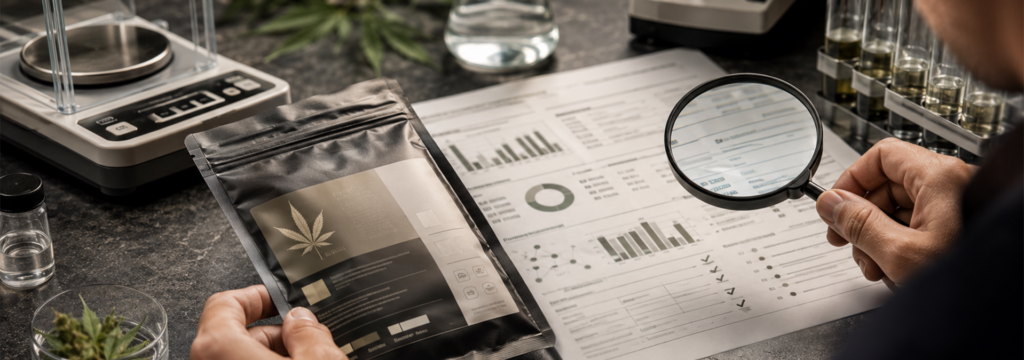
Every cannabis product sold at a licensed California dispensary must carry a state-mandated label. Behind that label sits a certificate of analysis (COA) issued by an independent, accredited laboratory. Together they tell you exactly what is in the package, how potent it is, and it cleared every safety test the Department of Cannabis Control (DCC) requires.
Most shoppers glance at the THC percentage, move on. That number alone misses a lot. This guide walks through every field on the label, every section of the COA. You can make an informed purchase, avoid red flags, and understand exactly what you are putting into your body.
What Is on a California Cannabis Label?
Under California law (Business, Professions Code §26120, DCC regulations), every retail cannabis package must display the following elements:
| Label Field | What It Means |
| Business / brand name | The licensed retailer / brand behind the product. |
| Universal symbol | A red exclamation point inside a diamond with the words ‘CA’ above, required on every cannabis product sold in the state. |
| Government warning statement | “This product has intoxicating effects, may be habit forming. Smoking is hazardous to your health.” |
| Net weight / volume | Expressed in metric, US customary units. |
| THC, CBD content | Milligrams per package, per serving (for edibles/beverages) / a percentage for flower, concentrates. |
| Batch / lot number | Ties the product to its lab test, which is critical for traceability. |
| Packaged-on date | Determines freshness; different from the harvest date. |
| Best-by date (if applicable) | Required for edibles. |
| Manufacturer’s license number | Verify this against the DCC license lookup to confirm the product is legal. |
| Distributor’s license number | The entity that moved the product through the supply chain. |
| Retailer’s license number | The dispensary you purchased from. |
| Ingredients (for edibles) | Listed in descending order by weight, including allergens. |
| “Do not drive” symbol | A car with a red X, mandated by the DCC. |
| Child-resistant packaging indicator | Confirms the closure meets ASTM child-resistance standards. |
Tip: If any mandatory field is missing, the product may be unlicensed / mislabeled. Walk away.
What a Certificate of Analysis (COA) Is, Why It Exists
A certificate of analysis (COA) is the official lab report issued by a DCC-accredited third-party testing laboratory after analyzing a batch of cannabis. California law requires distributors to submit every batch for testing before it can enter retail. The COA certifies the batch passed / failed every required safety test.
A California COA must cover:
- Cannabinoid potency
- Terpene profile (optional. Increasingly standard)
- Pesticide screening (66+ compounds)
- Heavy metals (arsenic, cadmium, lead, mercury)
- Microbiological contaminants (total yeast/mold, E. Coli, Salmonella, Aspergillus species)
- Residual solvents (for concentrates, extracts)
- Moisture content, water activity (for flower)
- Foreign matter inspection
The COA must be publicly accessible. Reputable brands post a QR code on the label that links directly to the report. You can request it from the budtender / search the brand’s website by batch number.
How to Read Total THC, Total CBD: Why the Math Differs from the Headline Number
Most label confusion starts with THCA. Raw cannabis flower contains THCA (tetrahydrocannabinolic acid), which is non-intoxicating in its natural form. Heat from combustion, vaporization, / decarboxylation converts THCA to THC, the compound that produces psychoactive effects.
The conversion formula used on California labels is:
Total THC = (THCA × 0.877) + THC (delta-9)
The 0.877 factor accounts for the molecular weight difference between THCA, THC during decarboxylation. A flower labelled ‘25% THC’ is almost entirely THCA, maybe 28–29% THCA, with a small amount of active delta-9 THC. See our detailed breakdown in our THCA guide (internal link: existing post #16).
The same formula applies to CBD, CBDA. Total CBD = (CBDA × 0.877) + CBD.
On a COA, look for a column labelled ‘Total THC (as consumed)’ / ‘Total Potential THC’. This is the number the label must legally display. If you only see a THCA number without the calculated total, the COA may be incomplete / from a less rigorous lab.
Terpene Results, What They Tell You
Terpene testing is not required by California law. It is increasingly offered by premium cultivators. A terpene panel shows which aromatic compounds are present, at what concentration (usually expressed as a percentage of total weight / in mg/g).
Why terpene data matters:
- Flavor, aroma: myrcene (earthy/musky), limonene (citrus), pinene (pine), linalool (floral), caryophyllene (spicy/pepper) each contribute distinct sensory qualities.
- Effect nuance: the interaction between cannabinoids, terpenes, often called the entourage effect, shapes the subjective experience beyond raw THC percentage.
- Freshness indicator: terpenes are volatile, degrade over time. A low total terpene percentage on flower that was recently packaged may indicate poor cure / improper storage.
- Authenticity: strain-specific terpene fingerprints can confirm genetic claims when you know what to look for.
For a full explanation of individual terpenes, see our terpene guide (internal link: existing post #5).
Contaminant Screening: Pesticides, Heavy Metals, Microbials, Residual Solvents
This section of the COA is the safety backbone of legal cannabis. Each category has a DCC action level, meaning the concentration above which a batch fails, cannot be sold.
Pesticide Screening
California tests for 66 pesticides across two categories: Category I (zero tolerance, any detection = fail), Category II (action limits by compound). The COA will list each compound, the detected amount (or ‘ND’ for not detected), the action limit. Every cell in a passing batch should show ND / a value below the action limit.
Heavy Metals
The four regulated metals, arsenic, cadmium, lead, mercury, can bioaccumulate in the cannabis plant from contaminated soil. Action limits are expressed in micrograms per gram (µg/g). Flower tends to have lower limits than concentrates: of the volume consumed.
Microbiological Contaminants
Flower, pre-rolls are tested for total yeast, mold (TYMC), total aerobic microbial count (TAMC), pathogenic E. Coli, Salmonella, four Aspergillus species (A. Fumigatus, A. Flavus, A. Niger, A. Terreus). A single CFU detection of any Aspergillus species is a fail. This matters especially for immunocompromised patients.
Residual Solvents
Concentrates, extracts made with hydrocarbon, CO₂, / ethanol solvents must pass residual solvent testing. Class 1 solvents (benzene, toluene) have near-zero tolerance. Class 2 solvents (butane, propane, ethanol, heptane) have action limits typically in the hundreds of parts per million. Look for ‘Pass’ on every line, not just the summary row.
| Category | What to Look For | Pass Indicator |
| Pesticides | 66 compounds, Category I & II | ND / below action limit |
| Heavy Metals | As, Cd, Pb, Hg in µg/g | Below DCC action limit |
| Microbials | TYMC, TAMC, E. Coli, Salmonella, Aspergillus spp. | Pass / ND for pathogens |
| Residual Solvents | Butane, propane, ethanol, benzene, etc. | Pass / below action limit |
| Moisture / Water Activity | % moisture, Aw value | Aw < 0.65 for flower |
Batch Numbers, Test Dates, Packaged-On Dates
Three dates appear on / with California cannabis packaging. Each tells you something different:
- Test date: The date the laboratory analyzed the sample. By law this must be within 12 months of the retail sale.
- Packaged-on date: When the product was sealed into its final retail packaging. For flower, freshness begins to decline meaningfully after six months.
- Best-by / expiration date: Required for edibles, beverages. Reflects food safety, not just potency.
The batch number (known as the lot number) is the single most important traceability tool. It appears on the product label, the COA. Matching numbers confirm the COA was issued for the product you are holding. A mismatch / a missing batch number is a serious red flag.
Red Flags: Missing Licence Numbers, No Batch ID, Expired Testing
- No manufacturer / distributor licence number: You cannot verify the product is legal. Walk away.
- Batch number on the label doesn’t match the COA: The COA may belong to a different, possibly better-performing, batch.
- Test date older than 12 months: The batch has exceeded the California legal window for retail sale.
- COA from an unaccredited lab: Verify the lab holds DCC accreditation at cannabis. Ca. Gov. Unaccredited lab results are not legally valid.
- Missing contaminant categories: A COA that only shows potency is incomplete. Full compliance testing includes pesticides, metals, microbials, (for extracts) solvents.
- All-pass checkboxes with no underlying data: A COA should show individual compound results, not just summary pass/fail stamps. Summary-only reports cannot be independently verified.
- No QR code / COA link: Reputable brands make their COAs publicly accessible. A brand that hides its lab results has a reason to hide them.
- Suspiciously high potency numbers: Verified flower rarely exceeds 30–32% total THC. Consistently higher numbers across a brand’s entire catalogue suggests inflated testing.
How to Find the COA for a Product You Already Bought
There are four ways to locate a COA after purchase:
1. Scan the QR code on the packaging. This is the fastest method, linking directly to the batch-specific report on the brand’s website.
2. Visit the brand’s website, look for a ‘Lab Results’, ‘COA’, / ‘Transparency’ page. Search by batch number / product name.
3. Ask your dispensary. Licensed retailers are required to make COAs available on request. The budtender can pull it up on-screen / print a copy.
4. Check cannabis review platforms such as Leafly, Weedmaps, / similar. Many brands upload their COAs to product pages on these platforms.
If none of these methods produce a COA, treat it as a red flag. You can check if the seller holds a valid licence using the DCC’s public license verification tool. See our guide to verifying a licensed California cannabis service (internal link: existing post #20).
Frequently Asked Questions
What does COA stand for in cannabis?
COA stands for Certificate of Analysis. It is an official lab report issued by a DCC-accredited independent testing laboratory certifying that a specific batch of cannabis has been analyzed for potency, terpenes, pesticides, heavy metals, microbiological contaminants, (for concentrates) residual solvents. In California, a passing COA is required before any cannabis product can enter retail sale.
Why is total THC different from THCA on the label?
Raw cannabis contains mostly THCA, the acidic, non-intoxicating precursor to THC. THCA converts to THC only when heated (smoked, vaped, / decarboxylated). California labels must show Total THC, which is calculated as (THCA × 0.877) + delta-9 THC. The 0.877 factor accounts for the molecular mass lost during conversion. A label showing ‘25% THC’ likely contains roughly 28% THCA, a small residual delta-9 THC percentage in the raw flower.
What is the California cannabis universal symbol?
The California cannabis universal symbol is a red exclamation mark inside a red diamond with the letters ‘CA’ printed above. It must appear on every cannabis product sold at a licensed California dispensary. Its purpose is to quickly identify the package as containing cannabis, particularly as a warning to children and adults unfamiliar with legal cannabis packaging.
How do you know if cannabis was lab tested?
A legally sold California cannabis product must include a batch number, a licensed distributor number, a passing COA from an accredited lab. Look for a QR code on the packaging that links to the COA, / ask the dispensary for the lab report. If it exists, the product may not have been legally tested. You can verify the testing laboratory’s DCC accreditation at cannabis. Ca. Gov.
How recent should a cannabis COA be?
Under California DCC regulations, a batch must be tested within 12 months of the date it is offered for retail sale. Most dispensaries stock products with COAs from within the past six months. For flower, freshness matters beyond compliance. Terpenes, potency degrade over time. A product packaged more than six months ago may be noticeably less aromatic / potent than a fresher batch.