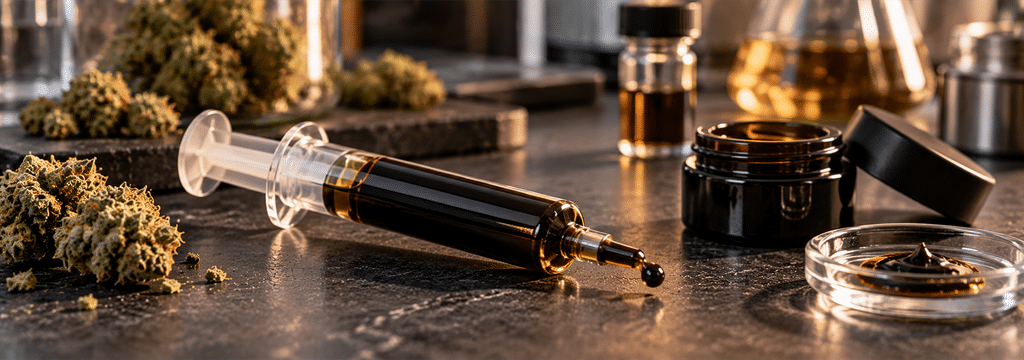
If you have heard the term RSO and are trying to figure out what it actually is, you are not alone. Rick Simpson Oil is one of the more discussed products in the cannabis concentrates category, particularly among patients who are exploring cannabis for health-related purposes. This guide covers what is RSO, how it is made, how it compares to other concentrates, and what to look for when buying it from a licensed California delivery service.
Note: This content is for informational purposes only and does not constitute medical advice. Canna Lala is a licensed retailer, not a medical provider. Consult a licensed healthcare provider before using cannabis for any health-related purpose.
What Is RSO (Rick Simpson Oil)?
RSO, or Rick Simpson Oil, is a highly concentrated full-extract cannabis oil made using a whole-plant extraction process. It is dark in color, thick in consistency, and significantly more potent than most other cannabis products.
RSO takes its name from Rick Simpson, a Canadian cannabis activist who developed this extraction method in the early 2000s. After sharing his personal story publicly, the term spread rapidly through the global cannabis community. For more background, see this resource on Rick Simpson Oil background from Leafly.
As sold by licensed California retailers, RSO is a cannabis concentrate product. It is not a pharmaceutical product and has not been approved by the FDA for any medical use. That distinction matters: this is a regulated cannabis retail product, not a drug approved through clinical trials.
RSO is sometimes sought by medical cannabis patients who are exploring options for symptom management. Any therapeutic use of cannabis, including RSO, should be discussed with a licensed physician before proceeding. Canna Lala is a retailer, not a medical provider, and nothing in this guide is medical advice.
How RSO Is Made and Why It Looks Different
RSO is a whole-plant extract. The extraction process uses a high proportion of the cannabis plant rather than targeting isolated compounds. This approach is what gives RSO its distinctive appearance and cannabinoid profile.
The basic process works as follows: a solvent dissolves the cannabinoids, terpenes, and plant waxes from the plant material. The solvent is then evaporated, leaving behind a thick, concentrated oil. In the original Rick Simpson method, consumer-grade solvents such as isopropyl alcohol were used. Licensed California commercial producers use food-grade ethanol or other solvents approved under state regulations.
The dark brown to near-black color of RSO comes directly from what remains in the oil. Chlorophyll, plant waxes, and other compounds stay in because the extraction is not refined or filtered as heavily as distillate. This is by design, not a sign of lower quality.
Distillate is produced through the opposite approach. Multiple filtration and distillation steps remove plant material and isolate cannabinoids, producing a clear or light-gold oil with a neutral taste. RSO keeps more of the plant’s compounds intact, which explains why the two products look and taste so different.
A key safety point: homemade RSO made using consumer solvents carries real risks from the solvent itself. Licensed commercial RSO in California is produced in regulated facilities, uses approved solvents, and must pass testing for residual solvent content before it can be sold. Always buy from a licensed retailer. You can review California DCC concentrate regulations for more on what licensed producers are required to meet.
RSO Versus Distillate Versus Live Resin: Comparison Table
The table below compares RSO, distillate, and live resin across the factors that matter most to buyers. This is the clearest way to see where RSO fits in the broader concentrate market.
| Feature | RSO | Distillate | Live Resin |
| Extraction method | Whole-plant solvent extraction (ethanol) | Multi-step refinement and distillation | Fresh-frozen plant, solvent extraction |
| Color and appearance | Dark brown to near-black | Clear to light gold | Amber to golden yellow |
| Consistency | Thick, syrup-like or paste-like | Runny to medium viscosity | Ranges from liquid to semi-solid |
| THC potency range (approximate) | 60 to 90% total cannabinoids | 85 to 95% THC | 60 to 90% total cannabinoids |
| Full-spectrum? | Yes, broad cannabinoid and terpene profile retained | No, primarily THC with limited terpenes | Yes, high terpene retention from fresh-frozen process |
| Flavor and taste | Earthy, plant-forward, intense | Neutral, minimal flavor | Strong, aromatic, cultivar-specific |
| Typical use method | Oral (sublingual or in food), topical | Vape cartridges, edibles, oral | Dab rigs, vaporizers |
| Price range (relative) | Low to medium | Low to medium | Medium to high |
| Best for | High-potency oral or topical use, broad cannabinoid profile | Consistent potency, vaping, precise dosing | Flavor-focused dabbing and vaping |
RSO is the right choice for users who want a highly potent product for oral or topical use and value a broader cannabinoid profile. Distillate works best for users who need consistent, high-purity potency in a vape cart or edible. Live resin is ideal for users who prioritize flavor and the full aromatic profile of a specific cultivar.
Typical Potency and What That Means for Portioning
RSO typically contains 60 to 90 percent total cannabinoids. Most commercial RSO available in California is THC-dominant, though CBD-dominant RSO is also available for users who want to avoid significant psychoactive effects.
For context: most cannabis flower contains 15 to 30 percent THC. Most distillate vape cartridges fall in the 70 to 90 percent range. RSO sits in a similar potency range to distillate, but the comparison matters less than how it is consumed. Oral RSO behaves more like an edible than a vape product in terms of onset time and duration.
Because RSO is so concentrated, a very small amount visually contains a significant quantity of THC. The standard starting point in the licensed California market is roughly the size of a grain of rice, which corresponds to approximately 5 to 10mg of THC for most RSO products at typical potency. This is a general industry reference point, not a medical recommendation.
For new users: start with a grain-of-rice amount or smaller and wait at least two full hours before considering any additional amount. When consumed orally, effects typically begin 30 minutes to 2 hours after consumption and last 4 to 8 hours, depending on dose and individual metabolism.
How People Use RSO
Commercial RSO is versatile in application but is not appropriate for every consumption method. Here is a breakdown of the main approaches used with licensed California RSO products.
Oral consumption (most common)
RSO can be placed directly under the tongue for sublingual absorption, which produces a faster onset of roughly 15 to 45 minutes. Alternatively, it can be swallowed or mixed into food, producing an onset similar to standard edibles: 30 minutes to 2 hours.
Commercial RSO is typically packaged in a syringe applicator, which makes it practical to dispense a small, consistent amount. The syringe format is standard in the licensed California market. Duration of effects from oral RSO is generally 4 to 8 hours, depending on dose and individual metabolism.
Topical application
RSO can be applied directly to the skin. When used topically, it does not produce psychoactive effects because it does not enter the bloodstream in significant quantities through intact skin. Some users apply it to specific areas for localized purposes. Topical RSO is not a medical treatment, and no therapeutic claims are made here.
Adding to food
RSO can be mixed into food similarly to other cannabis oils. The fat content of food can improve absorption. Onset and duration are the same as with other oral consumption methods.
Vaping: not recommended
Commercial RSO is not formulated for vaporization. It contains plant waxes and other compounds that are not appropriate for inhalation. Using RSO in a vape device is not recommended. For vaping, distillate or live resin products are the appropriate choices.
What to Check on an RSO Label and COA
Every licensed California cannabis product must pass third-party laboratory testing before it can be sold. The results are documented in a Certificate of Analysis, or COA. Reviewing the COA before using an RSO product is one of the most practical steps you can take as a buyer.
Here is what to look for on an RSO COA:
- Total THC and total CBD: confirms actual cannabinoid content and helps you understand potency before dosing
- Residual solvents: must show a passing result. A failing result means solvent was not fully removed during production
- Pesticides: must show a passing result. Residual pesticides from cultivation can end up concentrated in cannabis extracts
- Heavy metals: must show a passing result. Cannabis plants absorb metals from soil, which can be concentrated during extraction
- Microbials: must show a passing result. Covers mold, bacteria, and similar biological contaminants
Most licensed California RSO products include a QR code on the packaging that links directly to the COA. If a product does not provide COA access, that is a strong reason not to buy it.
RSO from a licensed retailer has all of these test results on file as a legal requirement for sale. RSO from an unlicensed source does not.
Buying RSO from a Licensed California Retailer
RSO is readily available through licensed California cannabis retailers and delivery services. In the licensed market, the most common format is a syringe applicator in 0.5g or 1g sizes, which allows for small, controlled doses.
When choosing an RSO product, prioritize a clearly labeled product from a recognized brand, purchased through a DCC-licensed retailer. Confirm that a COA is accessible and that the key test categories (residual solvents, pesticides, heavy metals, microbials) all show passing results.
Canna Lala is a licensed California cannabis delivery service with same-day delivery available across the Los Angeles area, Inland Empire, High Desert, and Antelope Valley.
Frequently Asked Questions
What does RSO stand for?
RSO stands for Rick Simpson Oil. The name comes from Rick Simpson, a Canadian cannabis activist who developed and popularized this whole-plant extraction method in the early 2000s after sharing his personal experience publicly.
How strong is RSO compared to other concentrates?
RSO is highly potent, typically containing 60 to 90 percent total cannabinoids. This puts it in a similar potency range to distillate. Because RSO is typically consumed orally rather than vaped, the onset time and experience differ significantly. A grain-of-rice-sized amount is the standard starting point for new users.
Is RSO a full-spectrum extract?
Yes. RSO is generally described as a full-spectrum extract because the whole-plant process retains a broad range of cannabinoids, terpenes, and other plant compounds. This distinguishes it from distillate, which is highly refined and strips most plant material beyond the target cannabinoid.
How much RSO is a beginner amount?
A starting amount commonly cited in the licensed California market is approximately the size of a grain of rice, corresponding to roughly 5 to 10mg of THC for a typical RSO product. New users should start at this level or smaller and wait at least two hours before considering any additional amount. Onset is similar to edibles, so effects are not immediate.
Can you buy RSO from a licensed dispensary in California?
Yes. RSO is available through licensed California cannabis retailers and delivery services. Canna Lala is a DCC-licensed delivery service offering RSO and other concentrates for same-day delivery across Los Angeles, the Inland Empire, High Desert, and Antelope Valley.
Is RSO the same as cannabis oil?
Not exactly. ‘Cannabis oil’ is a broad term that covers many different products, including tinctures, CBD oil, distillate, and RSO. RSO is a specific type of cannabis oil distinguished by its whole-plant extraction method, its dark color, and its high potency. If you are exploring related terms in the cannabis concentrates category, what is THCA [URL MISSING] covers another commonly misunderstood product that is worth understanding separately.
Can RSO be used in a vape pen?
No. Commercial RSO is not formulated for vaporization. It contains plant waxes and other compounds that should not be inhaled. Using RSO in a vape pen or similar device is not recommended. For vaping, distillate or live resin products are the appropriate choices.
Disclaimer
21+ adult use only. This content is for informational purposes only and does not constitute medical advice. Consult a licensed healthcare provider before using cannabis for any health-related purpose. Canna Lala is a licensed cannabis delivery service operating under California DCC regulations.