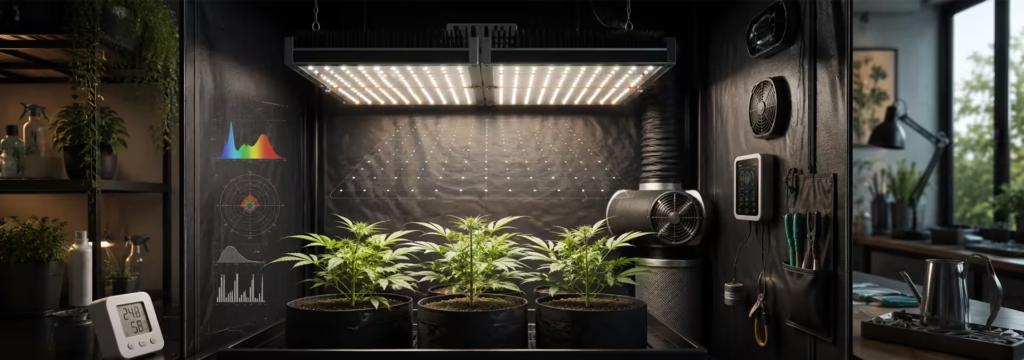
You have decided to grow cannabis at home. You have got a tent, a fan, maybe some soil. Now you are staring at a wall of grow light options online and every listing says “best LED grow lights for cannabis” and nothing tells you what actually matters.
This guide cuts through it. Whether you are growing in a 2×2 closet or a 4×8 tent, here is exactly how to pick the right light, what specs actually matter, and what you can skip.
What Wattage LED Grow Light Do I Need for Cannabis?
The short answer: plan for 30 to 50 watts of actual LED draw per square foot of canopy. A 2×4 tent (8 sq ft) needs roughly 240 to 400 true watts from the wall.
The trick is ignoring the advertised wattage on most cheap lights. A light listed as “1000W” might only pull 100 watts from the wall. That number is meaningless. What matters is the actual power draw (listed as “actual wattage” or “power consumption”) and how efficiently the light converts that power into usable plant light (measured in PPE or efficacy).
Here is a simple coverage guide:
| Grow Space | Actual Watts Needed | Recommended Light Size |
|---|---|---|
| 2 x 2 ft (4 sq ft) | 120 – 200W | Spider Farmer SF-1000 or similar |
| 2 x 4 ft (8 sq ft) | 240 – 400W | Spider Farmer SF-2000, Mars Hydro SP-250 |
| 3 x 3 ft (9 sq ft) | 270 – 450W | HLG 300L Rspec, Mars Hydro TS-1000 |
| 4 x 4 ft (16 sq ft) | 480 – 800W | HLG 600 Rspec, Spider Farmer SF-4000 |
| 4 x 8 ft (32 sq ft) | 960 – 1600W | Two HLG 600s or two Spider Farmer SF-4000s |
If you are not ready to commit to a full growth yet, Canna Lala delivers same-day to Los Angeles, Santa Clarita, Lancaster, Palmdale, Riverside, Victorville, and dozens more cities across LA and San Bernardino County. It is an easy way to explore strains before you grow them yourself.
What Is the Best Light Spectrum for Cannabis?
Cannabis needs blue-dominant light (5000 to 7000K) during vegetative growth and red-dominant light (2700 to 3000K) during flower. Full-spectrum white LEDs with a red boost cover both stages well.
Here is what each part of the spectrum does:
- Blue light (400 to 500nm): Drives compact, leafy vegetative growth. Keeps plants from stretching.
- Red light (620 to 700nm): Triggers flowering and drives bud development. Critical in flower.
- Far-red (700 to 800nm): Speeds up the flowering response. Some modern lights include this.
- Green light (500 to 600nm): Penetrates deeper into the canopy. Often dismissed, actually useful.
Most quality LEDs today use full-spectrum white diodes with added deep red diodes. Lights labeled “Rspec” (like HLG’s lineup) are tuned specifically for cannabis with extra red output in the 660nm range. You do not need a light that changes spectrum by growth stage, but it is a nice feature if the price is right.
What Is PPFD and Why Does It Matter?
PPFD (photosynthetic photon flux density) measures how much usable light actually lands on your plants per second. It is the most accurate way to compare grow lights and determine whether your plants are getting enough light.
Think of PPFD like rainfall intensity. It is not just how much rain fell, it is how fast it hit the ground. The unit is micromoles per square meter per second, written as umol/m2/s.
Cannabis PPFD targets by growth stage:
| Growth Stage | Recommended PPFD (umol/m2/s) | Notes |
|---|---|---|
| Seedling | 200 – 400 | Too much light stresses young plants |
| Early vegetative | 400 – 600 | Ramp up gradually |
| Late vegetative | 600 – 900 | Strong growth, compact internodes |
| Early flower | 800 – 1000 | Begin transition to higher intensity |
| Peak flower | 1000 – 1500 | Max output with CO2 supplementation |
Most home growers without CO2 should stay in the 600 to 1000 range. Pushing past 1200 PPFD without CO2 often results in bleaching or light stress, not bigger yields.
When shopping, look for lights that publish a real PPFD map showing intensity at multiple points across the coverage area, not just the single peak reading in the center. A reputable brand like HLG or Spider Farmer will show you a full grid.
How Far Should LED Grow Lights Be from Cannabis Plants?
Most LED grow lights should be kept 18 to 24 inches above the canopy during veg and 12 to 18 inches during flower. High-intensity LEDs from brands like HLG may need to stay 24 to 36 inches away to avoid light stress.
Hanging distance changes by light output. Here is a general guide:
| Light Power (Actual Watts) | Veg Distance | Flower Distance |
|---|---|---|
| Under 100W | 12 – 18 inches | 10 – 16 inches |
| 100 – 250W | 16 – 22 inches | 14 – 20 inches |
| 250 – 500W | 18 – 26 inches | 16 – 22 inches |
| 500W and above | 24 – 36 inches | 18 – 28 inches |
Signs you need to raise your light: bleached white tips on colas, leaves cupping upward, stunted growth, or a washed-out color on the top canopy.
Signs you need to lower your light: plants stretching aggressively toward the light, pale green color, loose airy buds forming in flower.
Most good lights have dimmer controls, which is the smarter approach, start at 50 to 60 percent intensity and raise gradually over the first week in a new growth space.
LED vs HPS: Which Is Better for Home Growing?
For most home growers today, LED is the better choice. LEDs run cooler, use less electricity, and modern full-spectrum LEDs match or beat HPS yields. HPS still has a place for large commercial operations, but for a home tent in LA or Riverside, LED wins.
Here is the direct comparison:
| Factor | LED (Modern Full-Spectrum) | HPS (High-Pressure Sodium) |
|---|---|---|
| Energy use | Lower (1.5 to 2.5 umol/J) | Higher (1.0 to 1.7 umol/J) |
| Heat output | Low to moderate | High, requires cooling |
| Upfront cost | Higher | Lower |
| Bulb replacement | Not needed for 50,000+ hrs | Every 1 to 2 grows |
| Spectrum control | Full-spectrum, tunable | Fixed spectrum |
| Setup complexity | Simple | Requires ballast + reflector |
| California electricity cost | Favorable | Less favorable |
California electricity rates vary by utility but average around 25 to 30 cents per kWh in LA County and the Inland Empire. A 400W LED running 18 hours a day costs roughly 43 to 51 dollars per month on power alone. The equivalent 600W HPS setup would cost 65 to 78 dollars per month while also generating significantly more heat, which often means running an additional exhaust fan harder.
For anyone growing in an apartment or a space with limited ventilation in Santa Clarita, Palmdale, or the San Bernardino Valley heat, LEDs make the choice easy.
What Are the Best LED Grow Light Brands for Cannabis?
The three most trusted LED grow light brands for cannabis are HLG (Horticulture Lighting Group), Spider Farmer, and Mars Hydro. All three publish honest specs, use quality diodes, and have strong track records with home growers.
Here is a quick breakdown:
HLG (Horticulture Lighting Group)
The premium option. HLG lights use Samsung LM301H or LM301B diodes and are built in the US. Efficacy ratings are among the highest available (2.7 to 3.0+ umol/J). Best for growers who want top-shelf yields and are willing to pay more upfront. The HLG 300L Rspec and HLG 600 Rspec are community favorites.
Spider Farmer
The best value for most home growers. Spider Farmer also uses Samsung diodes and publishes real PPFD maps. The SF series (SF-1000, SF-2000, SF-4000) covers tent sizes from 2×2 to 4×4 and performs comparably to lights costing twice as much. The Spider Farmer SF-2000 is one of the most recommended beginner grow lights available.
Mars Hydro
A solid mid-range option. Mars Hydro lights are durable, consistent, and well-documented. The TS and SP series are popular in the home grow community. Not quite at Spider Farmer or HLG performance levels, but priced accordingly and widely available.
Brands to approach with skepticism: anything without published PPFD data, anything with a suspiciously low price from an unknown manufacturer, and anything marketing itself as “equivalent to 2000W HPS” without actual wattage numbers.
How Much Do LED Grow Lights Cost to Run Per Month?
A 300W LED grow light running an 18/6 veg schedule costs roughly 32 to 40 dollars per month in electricity at California rates. Running flower on a 12/12 schedule drops that to 22 to 27 dollars per month for the same light.
Here is the math:
Formula: (Watts / 1000) x hours per day x 30 days x cost per kWh = monthly cost
| Light Size (Actual Watts) | Veg (18 hrs/day) | Flower (12 hrs/day) |
|---|---|---|
| 100W | ~13/month | ~9/month |
| 200W | ~27/month | ~18/month |
| 300W | ~40/month | ~27/month |
| 400W | ~54/month | ~36/month |
| 600W | ~81/month | ~54/month |
Based on $0.27/kWh (Los Angeles average).
LED wins the cost comparison versus HPS every time. But the bigger variable for most California growers is summer cooling. A 600W HPS in a 4×4 tent during a Victorville or Riverside summer can push tent temperatures into the 90s, which means running a portable AC that costs as much to operate as the light itself. LEDs reduce that problem significantly.
What Light Schedule Should I Use for Cannabis?
Cannabis needs 18 hours of light and 6 hours of dark during vegetative growth, then 12 hours of light and 12 hours of dark to trigger and sustain flowering. Autoflowering strains flower on their own schedule regardless of light cycle.
Light schedule basics:
- Seedling: 18/6 or 20/4. Keep it simple.
- Vegetative: 18/6 is the standard. Some growers use 20/4 for faster growth.
- Flower: 12/12, flipped intentionally by the grower (for photoperiod strains).
- Autoflowers: 18/6 or 20/4 from seed to harvest. They do not respond to light schedule changes.
- Late flower light dep: Some growers drop to 10/14 in the last two weeks to push trichome ripening. Results vary.
One important note for California home growers: light leaks into the dark period during flower can cause hermaphroditism (the plant develops male pollen sacs). Make sure your tent is fully light-proof, especially if your grow space has windows or ambient light from neighboring rooms.
If you want to understand how different strains actually perform before committing to a full grow, Canna Lala offers same-day delivery across LA County, Lancaster, Palmdale, Riverside, and the Inland Empire. Try the flower before you grow it.
Is It Legal to Grow Cannabis at Home in California?
Yes. Under Proposition 64, California adults 21 and older can legally grow up to 6 cannabis plants per person at their private residence. The plants must not be visible from a public place and must be in a locked space if minors are present.
Key rules under California home grow law:
- Plant limit: 6 plants per person, regardless of how many adults share a residence
- Age requirement: 21 and older only
- Location: Private property only. Renters need to check their lease.
- Visibility: Plants cannot be visible from a street, sidewalk, or neighboring property
- Local rules: Some cities and counties have additional restrictions or bans on home cultivation. Los Angeles city allows it. Check your specific municipality.
- Selling: Illegal without a state license, regardless of quantity
- Consumption: Cannot smoke in public, in a vehicle, or within 1,000 feet of a school during school hours
Cities like Los Angeles, Santa Clarita, and Lancaster generally allow home cultivation in line with state law. Some unincorporated San Bernardino County areas have their own rules. If you are in Rancho Cucamonga, Upland, or Ontario, verify local ordinances before setting up a grow.
California’s electricity rates and climate make indoor grows very manageable from a cost standpoint, and the mild weather in LA County makes managing tent temperatures easier than growing in extreme desert heat during summer.
Frequently Asked Questions
What is the best LED grow light for a beginner?
The Spider Farmer SF-2000 is the most recommended beginner LED grow light for cannabis. It covers a 2×4 tent in flower, pulls about 200 watts from the wall, uses Samsung diodes, and ships with a real PPFD map. It is well-priced for what it delivers and Spider Farmer’s customer support is reliable.
Can I use any LED light to grow cannabis?
No. Regular household LEDs do not produce enough light intensity or the right spectrum to grow cannabis effectively. You need a purpose-built horticultural LED with high output in the photosynthetically active radiation range (400 to 700nm) and sufficient PPFD for your canopy size.
How many plants can I grow under a 300W LED?
Under a 300W actual draw LED in a 3×3 or 2×4 tent, you can effectively grow 2 to 4 plants depending on training method. If you run a Sea of Green (SOG) with smaller plants, you can fit more. If you grow one large plant with a SCROG, one plant can fill the space.
Do LED grow lights need to be on 24 hours a day?
No. Cannabis needs a dark period. Running lights 24/7 can stress photoperiod strains and prevent them from entering dormancy. Stick to 18/6 for veg or 20/4 at most. Autoflowers can handle 20/4 but do not need 24 hours on.
Are Spider Farmer LED grow lights good for cannabis?
Yes. Spider Farmer is widely considered one of the best value-for-money LED brands for cannabis. Their lights use Samsung LM301B or LM301H diodes, publish accurate PPFD maps, and perform comparably to premium brands at a lower price point. The SF series is a consistent recommendation in the home grow community.
What happens if my grow light is too close to cannabis?
Light stress. Signs include bleached or white tips on colas, upward-cupping leaves (known as “taco-ing”), and slowed growth. In severe cases, you can permanently damage the canopy. Raise the light, reduce the dimmer if your light has one, and give the plant a few days to recover.
Ready to Try Before You Grow?
Building out a home grow takes time, money, and a few runs to dial in. If you want to try premium cannabis flower while your setup comes together, or if you just want to know which strains you actually enjoy before investing in seeds, Canna Lala has you covered.
Same-day delivery across Los Angeles, Hollywood, Burbank, Glendale, North Hollywood, Santa Clarita, Lancaster, Palmdale, Riverside, Victorville, Hesperia, Rancho Cucamonga, Upland, Ontario, and dozens more cities across LA County and San Bernardino County.
Over 1,600 five-star reviews. Order today and get it the same day.